Showing posts with label Experiential learning. Show all posts

Saturday, 18 July 2026

Op Sindoor - Pride Without Prejudice

Shershah
Uri The Surgical Strike
Lagaan
Ain't these the titles of Hindi feature films?
Yes.
What about them?
These films make excellent teaching and learning aids.
How?
We let the students watch the film and then select few clips/instances for discussions in the class.
What do you discuss?
The lessons that can be drawn from the story. The correlation with relevant concept or theory being taught otherwise.
How does it help?
It helps in understanding the concepts and how is it useful in real life. It helps in internalisation of the concepts and theories as applicable. It makes the learning more experiential.
Sounds cool.

Add to the above list real life incidents or events in real-time. Such real-life events also help in experiential learning. And if done in real-time (immediately after the event), it generates a lot of debate and excitement in the class.
This story is based on a real-life event, Operation Sindoor. Although it happened in 2025, yet it re-surfaced few weeks ago. While teaching a one-semester core course on Project Management(PM), we chose Op Sindoor to bring out many concepts of PM. Sharing below some of the takeaways from the case discussions.

Was Op Sindoor a Project?
In simple terms, a project is one-off, not repeated, has a start and end, a well defined objective and outcome, which demand resources. The MBA class unanimously said yes it was a Project. See the pictures below of the two cohorts of 50 students each. They look energised after the case discussion, right?

Any reader who thinks otherwise, your views are welcome in the comment field.

Similarly, the discussion on following topics saw active participation from the students:
Who was the Project Manager?
What was the Objective of the Project?
How was it achieved?
How was Project Planning done? What were the options?
Who executed the Project?
Were multiple agencies involved in execution? How were they monitored and controlled?
What was the outcome? How was it measured?
Who were the stakeholders?
How was the communication to the stakeholders managed? Was it effective?
What were the risks? How was risk mitigation done?
Was it just a Military Operation? If not, what else and why?

Sharing another picture of the 'live' case discussion steered by Vaishnavi, one of the students.
Another student Vishwashanthi was present in J&K at the time of Pahalgam attack. She wrote, "In April 2025, I went on a trip to Jammu and Kashmir with my friends to explore its beautiful tourist destinations. We had been enjoying our journey and visiting different places. On 22 April 2025, while we were near the Vaishno Devi Temple in Katra, we heard the heartbreaking news about the Pahalgam attack."
"The news came as a complete shock. I felt scared and anxious because we were also in Jammu and Kashmir at that time. The atmosphere suddenly became tense, and everyone around us was talking about the incident and checking for updates. I immediately called my family to let them know that I was safe.Although we were safe, that moment reminded me how quickly situations can change. It was an experience I will never forget, and my thoughts and prayers are with everyone who was affected by the tragedy."
Thank you Shanthi for sharing your memories.

An opeartion like Sindoor has lessons in many other subjects and areas like, Strategy, Leadership, Decision Making under Uncertainty, Team Work, Goal Setting, Contingency Planning, Resource Mobilisation, Technology Adaptation, Media Management, International Relations etc. But we had restricted our discussions to the lessons in Project Management to keep the story short.

Corporate Lessons
While discussing the above questions, we also brought out the corresponding lessons for the corporate world. The whole exercise appeared very meaningful. The students seem to have internalised the Project Management topics with clarity and ease. Thank you the PGDM Class of 2027 at VVISM Hyderabad for your wholehearted participation.

Question for the Reader
Whether you are an MBA grad, student, working professional in any field, home maker, parent, grandparent, veteran or any other netizen, what was the most significant outcome of Op Sindoor? Mail your response to hbindia@gmail.com or leave a comment. Selected responses with names will be included as Postscript.
Postscript 28th July: None of the readers responded to the above query. However, two of the students nailed it! The most significant outcome of Op Sindoor was not the destruction of the terrorist camps but enhancing of the National Pride. Don't you think so?
End of Postscript.

The Title
Did you like the title of this story? The credit for suggesting the title goes to Padma Ramesh, an accomplished journalist and former Dean of a PG Institution of Media Studies. In her own words:
"I thought of Pride and Prejudice, Jane Austen's novel! (When I saw the word) --a Literary echo.
There is pride in what we achieved with Op Sindoor. The phrase "without prejudice" implies pride that isn't driven by bias or hatred."
Thanks Padma for creating such a befitting title for our story.

Experiential Learning - Some More
Ghumakkad has been a strong proponent of experiential learning. As a child, most of our learning has been experiential. Learning by doing, simple yet effective. But as we go up the 'education' ladder, experiential learning takes a back seat. It is more of lecturing. Sharing below some of my endeavours at experiential learning for my MBA students. You may click the link to browse the corresponding story.

Uri The Surgical Strike - Many lessons in Management from a feature film
Shershah Beyond The Movie - Based on the real-life story of Capt Batra of Kargil fame, the movie brings out many lessons in Leadership, Team Work, Task Orientation etc
Teachers Also Love Outdoors - Real learning happens outside the classroom.
Real-Time Cases for MBA Teaching - How to design and conduct the classes for enhanced experiential learning. Faculties are free to reach me for details.

Thanks for browsing. Do share your experience of making the teaching and learning more experiential.
We firmly believe that knowledge gets multiplied when shared.

Stay connected.

   - Harsh-the-Ghumakkad/ Secunderabad/ 18th July 2026/ hbindia@gmail.com 

Postscript:
21 July: Vinay Bhargava, an experienced marketeer wrote; "Indeed military operations are very inspirational as it involves clear aim, astute planning, dedicated research, inputs, execution etc.
In our marketing campaigns to inspire sales team we based many on wars and used terms as pincer movement in strategies. Excellent!"

#learning #teaching #ExperientialLearning #VideoCases #CaseMethod #MBA #PGDM #VVISMHyderabad #OpSindoor #Shershah #UriTheSurgicalStrike #LearningFromMovies #ManagementEducation #RealLife #RealTime #PahalgamAttack #ProjectManagement


Saturday, 14 February 2026

Learning From Each Other

When a teacher teaches a student, how many are learning?
Not one but two! Because the teacher also learns.

You may have heard or read it before. But Ghumakkad has been a firm believer in above dictum. It came alive earlier this week when I was invited to launch the opening day of a 14-day residential workshop on Project Management for senior officers from Nagaland Civil Service (NCS). It was organised by MCR HRD Institute, Hyderabad under the Capacity Building Program. The participants had travelled all the way from Nagaland to attend the Workshop. It was a privilege to be the opening resource person for the Workshop. Although I had taught at the Institute on many occasions earlier, it was after many years that I was back at the sprawling Jubilee Hills campus.

Project Management
All the five stages of Project Management as listed below are well known:
  1. Initiation
  2. Planning
  3. Execution
  4. Monitoring and Control
  5. Closure and Evaluation
Experiential Learning
All the above topics were to be convered in detail in the remaining 13-days of the workshop. Therefore, what I decided was to launch the topic with real-life examples and lessons. These examples were shared not only by me but also by the participants themselves. It made the whole learning process more experiential. The real-life examples from their own State added value to our discussions. Experience sharing by the participants consolidated the underlying concepts and helped in internalisation of learning. It made the whole process interactive and worthwhile more so when I had to engage them for six hours on Day-1!

Issues Discussed
Some of the live issues concerning large government projects that were discussed are listed below:
  1. Is the project really needed? Who gets benfitted and how?
  2. Community buy-in of the project
  3. Scope creep- how to deal with changes in project Scope
  4. Measuring the Impact
  5. Ensuing the quality of project execution
  6. Replicability of the Project across other districts and States
Learnings for the Teacher
As I said a teacher also learns in the classroom. I had many takeaways from the interaction with the experienced officers of NCS. Some of the learnings are:
  1. Development challenges in Nagaland
  2. Cultural diversity across hill tribes
  3. Fragile ecological system
  4. Rich bio-diversity of the region
  5. Excellent communication skills specially in English
  6. Regional and national aspirations
Gratitude
I wish to thank all the participants from NCS for their patient listening and active participation. On completion, they surprised me by honouring me with their traditional hand-made stole brought from Nagaland. I felt deeply humbled to receive this honour.  


About the Stole
Called Konyak (or Kongnai in local Ao dialect), these stoles and shawls are iconic traditional handwoven textiles from Nagaland, characterized by their specific tribal motifs and cultural significance.These stoles are more than clothing; they represent tribal identity and ancestral roots. Historically, certain patterns were reserved for warriors or clan leaders. They typically feature bold colors like red (bravery), black (strength), and white (purity). Naga traditional shawls and stoles have received a Geographical Indication (GI) tag, recognizing their unique origin and traditional production methods.

Am reminded of a quote by Calvin Coolidge who said, "No person was ever honoured for what he received. Honour has been the reward for what he gave." Once again thank you all the NCS officers for your gesture.

Other Workshops
Workshops are a great way to learn especially for working professionals. Am sharing below the links to some of the workshops conducted by me on various topics. Just click the link to browse the corresponding story.
Teaching Design Thinking Differently - When your MBA students don't want to recommend the college to others, what do you do? Think differently. Click the link.

How to Empower the Volunteers? - 3Es of volunteering by Ghumakkad

More Than A Prison - A workshop for the officers from the prison department on personality development.

Make In India and Military Systems - A workshop at IIM Indore. Have we gone beyond the rhetoric? 

Workshops if conceived well and designed for 'doing' rather than 'slide-shows', are a great way of learning. The above examples would have given you a taste and flavour. Should you need any help, do reach out to me on email hbindia@gmail.com .

Thanks for browsing. Stay connected and do leave a comment. It encourages us.

   - Harsh-the-Ghumakkad/ Secunderabad/ 14th Feb 2026

#workshops #learningbydoing #educatingtheprofessionals #teaching #learning #interactivity #participants #diversity #internalisation #reallife #ghumakkadhb #ghumakkadharsh #scopecreep


Saturday, 30 March 2024

Teaching Design Thinking Differently

'Design Thinking- such a drab subject!'

'We know the five phases - EDIPT!' 

'We have seen enough examples on YouTube.'

When your MBA class is so forthright in expressing their views, you have to think differently. Taking a cue from Dr Abdul Kalam's famous quote 'Creativity is seeing the same thing as everybody else, but thinking differently', we converted the remaining sessions of the course 'Innovation In Business' into a Design Thinking Workshop. In a workshop you are supposed to use some 'tools' and 'do'  and 'make' something like in a carpentry workshop. 

We asked the class if they would recommend the college to others? The answer was a chorus 'No'! Do they regret the decision when they joined the college? This time another chorus 'Yes'! When asked why, many reasons came up. That ignited Ghumakkad's mind to do a 'live' workshop on issues plaguing the students' minds. For a class of 70 students, we identified 24 'live' issues being faced by the students. Teams of three each were free to choose any one issue. The process was repeated for both the sections of 70 students each. The die was cast. Few of the issues selected by the students are listed below. Am sure students at other colleges would not feel much differently.

  • Improving student quality
  • Developing college pride & sense of belonging
  • Branding of the College
  • Entrepreneurial Support
  • Attendance through biometrics

Each team was given 48 hours to complete the first step of Design Thinking 'Empathise'. It involved interacting with the people concerned for the issue at hand. It could be other students, faculty, staff or management of the college. It could also be other colleges in the same geography. By actually empathising with the people concerned, the students learnt the nuances of Step-1 of design thinking. Whether it was mere observations or an interview or a focussed group discussion or collection of facts and figures, the students gained 'insights' of the issue at hand. These insights were then utilised for further steps of Design Thinking.

Remaining steps namely Define, Ideate, Prototype and Test were completed by each team after two days in the class itself. Breakout areas gave freedom for brainstorming. The teams had two hours to deliberate the issue and apply the design thinking to come up with suggested solution. The teams were also given a chart paper and coloured markers to summarise their design thinking effort and present it to the class for greater learning. The posters were thereafter displayed in the college foyer for wider viewership by other students, faculty, staff and management of the college. The whole event thus generated lot of enthusiasm and energy by the students in experiential learning mode. Sharing few pictures of the event below.


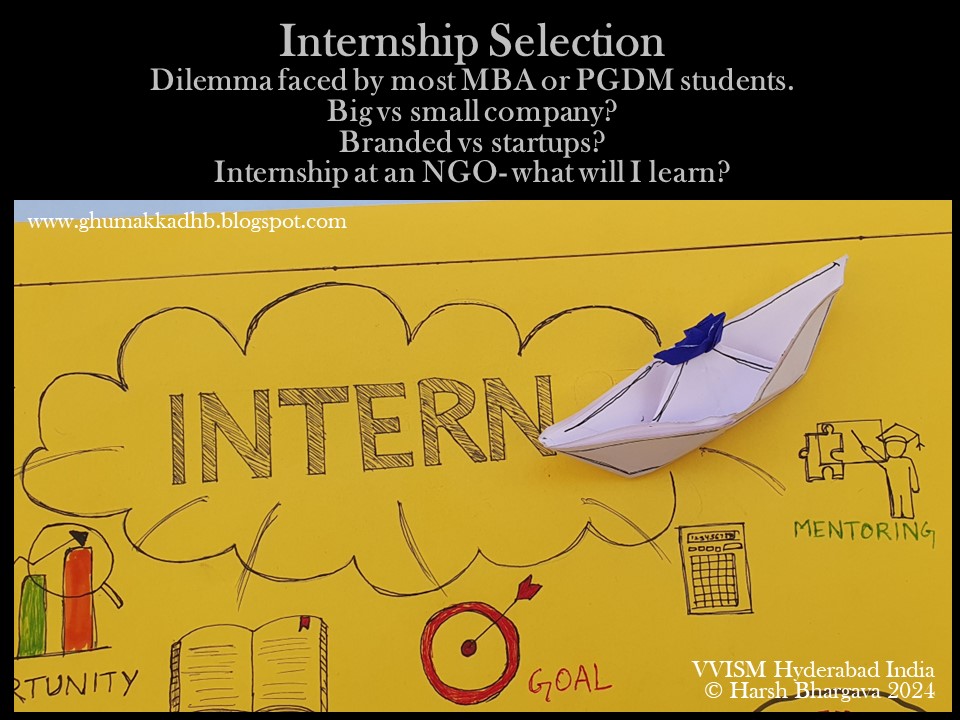
Through the workshop, the students could address many real-life issues like how to select the internship company? Big vs small? Branded company vs a startup? And so on.

The whole design thinking workshop was conceived on the go. The idea came because of students' disenchantment with the college (a normal reaction towards the end of the two-year-PGDM-program). Germinated in the class, a 'drab' subject was successfully transformed into an invigorating and participative workshop. It led to experiential learning. See the video clip below of the poster designing in progress.

For teachers like Ghumakkad, there is never a dull moment. With 140 inquisitive and restive minds around, it is a pleasant challenge to devise and conduct such 'live' learning events. Special thanks to all the students who participated, both the class reps and Dr V Jayashree for the wholehearted support.


Sharing below the links to some of our other 'live' teaching and learning events which had also ensured experiential learning at PG level:

Uri the Movie- Management Lessons

Shershaah Beyond The Movie

Real Life to Real Time Cases

Hope you enjoyed the teaching and learning of Design Thinking with Ghumakkad. Do share your experiences of other modes of experiential learning.

Thanks for browsing.

   - Harsh-the-Ghumakkad with the PGDM Class of 2024@VVISM Hyderabad/ 30th March 2024

#learning #experiential #PGDM #MBA #highereducation #nep2020 #designthinking #workshopmode #reallifeissues #insights #innovationinbusiness #creativity #learningbydoing #ghumakkadhb #ghumakkadharsh


Thursday, 1 August 2019

Startup Ideas

Startups are fun.
Teaching Startup Management is greater fun.
How?
Because you see the ideas sprouting in the minds of future entrepreneurs.
Another season of teaching Entrepreneurship and Startup Management for Ghumakkad-the-teacher. Within three hours of launching the subject, my PGDM students were asked to identify an opportunity which could become an idea for a Startup. Most of the students had no prior work-ex. Yet, they could think of startup ideas which showed the following characteristics:

  1. It addresses a 'need' of prospective customer or society
  2. May not be unique but has potential
  3. Rides on innovation
  4. Is doable
  5. Ideas span across industry sectors
  6. Product-based ideas also
  7. Social venture ideas
  8. Addresses the needs of rural India as well
Here is a summary of some of the 50-odd ideas submitted by the students.


For a teacher who believes in learning-by-doing, it is immensely satisfying when the students apply themselves. Kudos to the Class of 2020. Let your dreams soar. But keep your feet on the ground and do the home work well. This is just the beginning.
CAP stands for continuous assessment plan. There are a series of CAP activities during the semester.
All the best for the upcoming B-Plan Contest.

    -  Harsh-the-teacher-and-Ghumakkad/ 1st Aug 19


 #Startups #entrepreneurship #identifyingopportunity #learningoutcomes #learningbydoing #experientiallearning #MBA #PGDM #VVISM #ghumakkadharsh #ghumakkadhb #startupideas #startupIndia #Startupsarefun

Tuesday, 23 April 2019

Real Life to 'Real-Time' Cases

Is it a typo? 'Real-Time' Cases?
Haven't heard it before!
If you felt the same way, then you need to read further.

Real-life cases always generate more discussion in an MBA class. But many times such cases get outdated very fast. Subsequent corporate events which unfold after the case was written and it gets discussed in the class, make it less relevant and impactful.

What can the faculty do in such situations?
The key is to move from real-life to real-time. Yes, real-time as in the case of military combat systems. Tracking a target in real time, engaging with your weapons in real time and assessing the impact- all in real time! Sounds cool?
But, how can this concept of ‘real-time’ be introduced in case-based teaching?
Can real-time cases be used across all management subjects?
How to design such real time cases?
What is the lead time to prepare such cases?
From where can we source such real-time cases?
Has this methodology been tried out somewhere?
What is the impact of such real-time case methodology on learning by management students?

Ghumakkad a.k.a. Harsh Bhargava will answer these and many more queries in a Workshop-cum-Master Class this week. It will introduce the faculties to ‘real-time cases’ through some ‘real-time’ cases in a recursive way!

Take your call because today's generation is media-driven, tech-savvy and hates reading long notes, handouts or cases.
Happy learning.

Reach me for further details
     
   -Harsh-the-Ghumakkad/23rd April 2019/ hbindia@gmail.com 

#learning #experientiallearning #mba #casemethod #pedagogy #reallifecases #realtimecases #learningforlife

Wednesday, 6 February 2019

Uri The Movie with Many Lessons in Management

"How is the josh?" "High Sir!"
"हिंदुस्तान घुसेगा भी और मारेगा भी"
"There is no silver medal in war"
"वक़्त आ गया है ख़ून का बदला ख़ून से लेने का"
And many such dialogues reverberate after one sees the recent Hindi movie 'Uri The Surgical Strike'. Apart from topping the box office collections, the movie has many lessons in Business Management.

The entire PGDM class of 2020 of VVISM Hyderabad was taken to a multiplex for watching the movie. The students came back all charged up. It was then that Ghumakkad decided to run a Case Study based on the movie. It was very satisfying when the students brought out the following concepts through various events/scenes in the movie.

  1. Team work at multiple levels
  2. Goal setting
  3. Alignment of individual goals with org goals 
  4. Role clarity of every team member
  5. Dealing with Uncertainty
  6. Leadership
  7. Planning and execution
  8. Motivation
  9. Communication
  10. Selection of Team 
  11. Emotional Quotient and its power
  12. Coordination
  13. Role of technology in achieving goals
  14. Physical and moral courage
  15. Service before self
  16. Humility
  17. Tag-line and impact on marketing
  18. The Power of Networking (Serial Nos. 18 to 22 courtesy Tarun Patro)
  19. Distraction Tactics
  20. Cost of a small mistake
  21. Paying attention to detail
  22. Back Up Plan or Plan B
        We found the movie to be a great learning aid for management students. There are many movies which I have used earlier for teaching. Some of these are listed below:
        Patton
        The Bridge On The River Kwai
        Wake Up Sid
        Dangal
        Lagaan
        Bajrangi Bhaijaan
        MS Dhoni: The Untold Story

        The challenge is to trigger the discussion with right questions. 
        Fellow teachers may reach me for further details on my mail ID. 
        Once again, thank you the Class of 2020 for an enriching session and VVISM for creating the right learning environment.

        Jai Hind!

        Thanks for browsing
             -Harsh-the-Ghumakkad/ 6th Feb 2019 
              hbindia@gmail.com 
        #casestudy #learning #experientiallearning #mba #pgdm #vvism1 #ghumakkadhb #ghumakkadharsh

        Thursday, 25 October 2018

        Learning from Failures


        “I flunked in my first semester.”
        “Me too!”
        Sounds familiar? We are not talking about the other kind of #MeToo!

        But what happened after the first semester? Did you bounce back? Most people did.
        And that’s the point.
        Did we learn from our failures in life? If we did, then we are on our way to success.

        As Swami Vivekanand had said, “Take risks in your life. If you win, you can lead. If you lose, you can guide”. We can help others not to repeat the mistakes we did. This applies equally well to the Startups.

        As part of the core course ‘Entrepreneurship and Startup Management’ in the PGDM program being taught by me, we included the topic ‘Learning from Failures’. The course participants had learnt all the foundation courses in Finance, Economics, Marketing, Statistics, IT, Operations, OB, HRM, Accounting, Business Laws, BRM etc in Semesters 1 and 2. Therefore, they were in a position to apply that knowledge to real life situations. 

        To make it more experiential, we assigned one startup each to a group of students. These startups had all been closed down or panic-sold in last twelve months. Each group had to study and analyse the failed startup and identify the reasons for failure. They were given 12 hours overnight to present their findings in the class. Although the mid-semester exams were on, the participants did a great job at researching and analysing. This post summarises the ‘Learning from Failures’ for few of the startups studied.

        Note: Our analysis is based on information available in open domain. The purpose of the study is for education and learning. It is not to be viewed as being judgmental. Should any reader like to supplement it with more facts and figures, we would be happy to update our analysis.


        The above methodology once again proves that best learning happens when we ‘learn by doing’!
        Class of 2019 at VVISM Hyderabad- keep it up.

        Our earlier posts related to Startups are listed below. Click on any link to read the full story.
        Can Startup Management be Taught?
        Proof of the Pudding- Inspiring Stories of Ghumakkad's Former Students-turned-entrepreneurs

        Fellow teachers and startups- you are welcome to share your experiences. 

        Thanks for browsing.

        -          Harsh-the-Ghumakkad/25th Oct 2018
        #startups #startupindia #failures #learningfromfailures #entrepreneurship #learningbydoing #ghumakkadhb #ghumakkadharsh #experiential 

        Tuesday, 4 September 2018

        A Teacher Keeps Learning

        Teachers' Day should actually be renamed as 'Learners' Day. 
        Why?
        Because every teacher learns more from being a teacher. If you don't believe me, ask any teacher. If you are a teacher, ask yourself.

        Learning never ends. Both for the students as well as the teacher.
        Whether teaching PG or school students, fellow teachers, industry professionals or military officers, teacher has to focus on learning.

        During the past year, Ghumakkad was fortunate to 'learn' from a cross-section of students/participants at following institutions/ organisations:

        • VVISM Hyderabad
        • IIM Indore
        • INS Shivaji Lonavla
        • United Health Group
        • Social Entrepreneurs from European Union
        • Centre for Social Initiative and Management Hyderabad
        • St Patrick's High School (Program for teachers)
        This story gives glimpses of some of these programs of learning. Photography was not permitted at few of the venues. Thanks are due to participants of each of these programs for enriching Ghumakkad's learning. Past one year was full of fun while learning!


        The students never fail to surprise a teacher! Like the spontaneous enactment of 'Dandalayya' a popular song from Telugu movie Bahubali. Moments like these move you. See the picture below.

        Ghumakkad wishes all his students, former students, fellow teachers and former teachers a very Happy Teacher's Day 2018. May God always be with you.

        Readers may browse Ghumakkad's posts on Teachers' Day of previous years listed below:

        We end with a PQ- picturesque quote from Ghumakkad's collection.

        Happy Teachers' Day once again to all.

        Thanks for browsing

             - Harsh-the-Ghumakkad/5th September 2018

        #teachersday #learning #teaching #experientiallearning #ghumakkadHB #ghumakkadharsh