Showing posts with label Identifying the Opportunity. Show all posts

Thursday, 1 August 2019

Startup Ideas

Startups are fun.
Teaching Startup Management is greater fun.
How?
Because you see the ideas sprouting in the minds of future entrepreneurs.
Another season of teaching Entrepreneurship and Startup Management for Ghumakkad-the-teacher. Within three hours of launching the subject, my PGDM students were asked to identify an opportunity which could become an idea for a Startup. Most of the students had no prior work-ex. Yet, they could think of startup ideas which showed the following characteristics:

  1. It addresses a 'need' of prospective customer or society
  2. May not be unique but has potential
  3. Rides on innovation
  4. Is doable
  5. Ideas span across industry sectors
  6. Product-based ideas also
  7. Social venture ideas
  8. Addresses the needs of rural India as well
Here is a summary of some of the 50-odd ideas submitted by the students.


For a teacher who believes in learning-by-doing, it is immensely satisfying when the students apply themselves. Kudos to the Class of 2020. Let your dreams soar. But keep your feet on the ground and do the home work well. This is just the beginning.
CAP stands for continuous assessment plan. There are a series of CAP activities during the semester.
All the best for the upcoming B-Plan Contest.

    -  Harsh-the-teacher-and-Ghumakkad/ 1st Aug 19


 #Startups #entrepreneurship #identifyingopportunity #learningoutcomes #learningbydoing #experientiallearning #MBA #PGDM #VVISM #ghumakkadharsh #ghumakkadhb #startupideas #startupIndia #Startupsarefun

Wednesday, 8 August 2018

Startups- Identifying an Opportunity

Want to set up a Startup?
Have an idea?
Does it address any 'need'? Whose need?
How to take the first steps?
How to identify the opportunity?

Everybody knows that startups are all about an opportunity, mobilising resources and creating and sustaining value. So, the start point is identifying the opportunity.


I   I teach a  core course titled 'Entrepreneurship and Startup Management' (ESM) to PGDM students at VVISM Hyderabad. One of the Learning Outcomes of the course is "To be able to identify the opportunity for creating a new business venture or social venture". The course focuses on learning-by-doing. After initial introduction to Entrepreneurship and Startups, the students were given few inputs on identifying the opportunity. See the excerpts of lecture slides below.


    And just after four sessions, they were asked to identify a business or social opportunity for a new venture. The students had to submit their idea in one page and make a one-minute elevator pitch


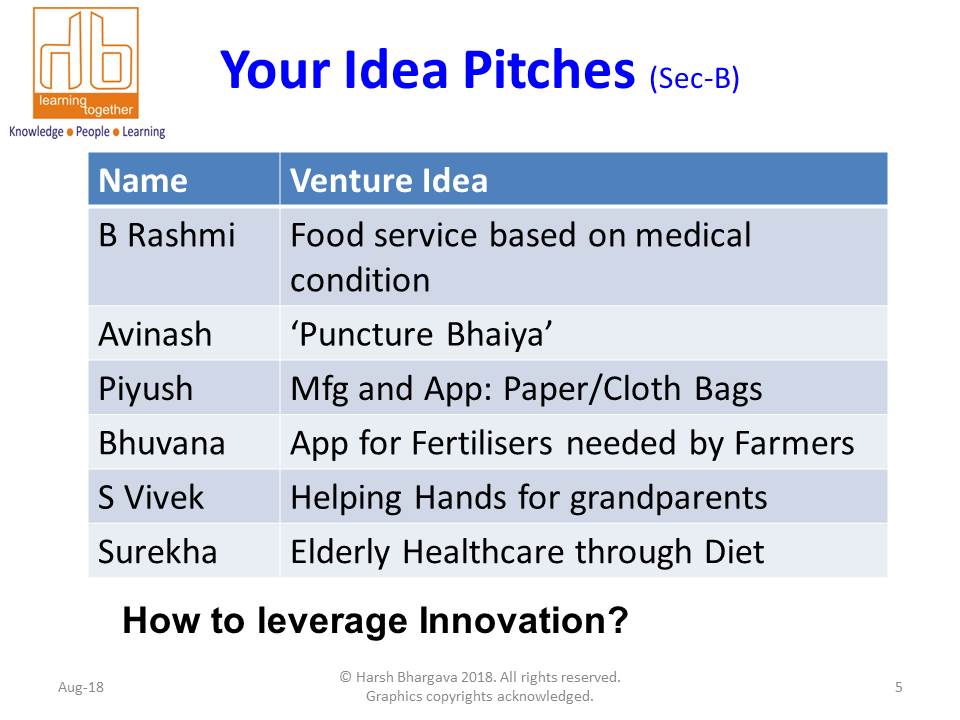
    Even though most students in the graduating Class of 2019 are freshers i.e. without work experience, they did a brilliant job. A summary of some of the startup ideas is given below.


   Did you notice any common thread in these ideas? Those familiar with the subject of ESM, may have observed the following:
  1.     Most of the ideas were innovative though some ventures may already be existing addressing similar needs.
  2.     The students could think of new ventures across industry sectors
  3.     The sample includes ideas for social ventures also
  4.     The students could identify new venture ideas that are needed for the rural population as well
  5.     Healthcare/eldercare seems to be a concern of the younger generation
    For a teacher like me it is satisfying to see when the students apply what we learn in the class. The next phase of developing these ideas into a Business Plan will follow. These individual ideas will now be debated, discussed and shortlisted for further team work. More on that later.

    A glimpse of the learnings and venture plans of the graduating class of 2018 can be browsed in the story 'Can Startup Management be Taught?'

   We close with a quote from Thomas Friedman, author of global bestseller 'The World is Flat'.


    If you are part of a startup or a teacher or a student, do share your experiences to further refine our learning-by-doing!  

   Thanks for browsing

      - Harsh-the-Ghumakkad/ 8th Aug 2018
     #Startups #entrepreneurship #identifyingopportunity #learningoutcomes #learningbydoing #experientiallearning #MBA #PGDM #VVISM #ghumakkadharsh #ghumakkadhb


Tuesday, 21 November 2017

Startup Management-- can it be taught?

Startup is the new buzzword. 
"Hey Dad I want to set up a startup" said a 20-year old graduate brimming with confidence.
"You switched job? Yes, I now work for a Startup!" was the response of a 30-year old former manager of Amazon.

This is not fiction. Startups are happening. It is the trend for today's ambitious youth. Be it Bengaluru, Gurgaon or Hyderabad, startups are being setup everywhere. Even the government is encouraging the startups in many countries. In India, both the central government and state governments have set up machinery to help the startup movement thrive. T-hub in Telangana is an excellent example. Similar startup engines exist in other countries.

Ghumakkad in his role as a teacher, was fortunate to launch a new course on 'Entrepreneurship and Startup Management' this year. It was taken by all the 70 students of two-year full-time PGDM program of Vishwa Vishwani Institute of Systems and Management (VVISM) Hyderabad. Run in the 3rd semester, the students had just returned from their summer internships. Having seen real life, they added value to the discussions in the class.


Designing a new course was not new to Ghumakkad. Having designed and conducted a new course on 'Social Entrepreneurship' in recent past, it was a challenge renewed. Taught to more than 200 PGDM students with field projects in 30 different organisations, it had given us lot of lessons. But an inter-disciplinary course of this nature can not be designed and conducted by one individual. Even for the course on 'Social Entrepreneurship' number of people had helped us create the course. Ghumakkad is grateful to the following for their contribution to the Startup course-- the students too deserve credit:

Coming to the question-- 'Can Startup Management be taught? Startups thrive on Innovation. Therefore, a course on Startup Management has to be innovative it its design and delivery. Some of the innovations which we introduced in the Startup course are listed below:

  • Startup Bites: An exclusive media bite by startup founders using WhatsApp. Recorded live based on our questions, it added realism and value to the course. We thank the following founders/others for their time and effort:


  • Do-it-yourself (DIY): While learning the tools like Business Model Canvas (BMC), each student had to create the BMC for an Indian startup. We thus created 70 BMCs of real-life startups.
  • Live Cases: Instead of conducting the case studies in the conventional manner i.e. circulate the case which is generally outdated, prior study, class discussions and lessons-- we went the 'live' way. A 'live' startup was selected for case discussions with internet access on-line. It generated lot of excitement besides experiential learning. It was wrapped up with 'live' bites from the founders.
  • On-line Rewards: Outstanding performance was rewarded with on-line coupons worth US $50 each for as many as six students. We acknowledge the support from Naman Munot in this regard.
  • Business Plan Contest: Every course on Entrepreneurship has a B-Plan contest. So, what was the innovation? The innovation was in designing a multiple-stage contest, applying a mid-course correction and jury which consisted of angel investors and founder CEOs.
  • Rubrics-based Assessment: Did the students really learn? Were the learning objectives achieved? We designed the rubrics for measuring the level of learning achieved by every participant. Although rubrics based assessment is widely used in USA and Australian universities, most Indian universities still use the traditional method of exams-answers-marks, which may not reflect the true 'level of learning' achieved by the student. We will share some extracts of rubrics based assessment later.
What were the Learning Outcomes (LOs) for the course?

Key Topics
The course covered the following key topics
  • Identifying the opportunity
  • Converting Idea into reality
  • Lean Startup
  • Business Model Canvas
  • Funding sources
  • What does a VC want
  • Angel Investing
  • Valuation of Startups
  • The Pitch
  • Business Plan
  • Exit potential
  • Learning from Failures
  • Contingency Plan
Did the students really learn?
Based on above LOs, nine sets of questions and corresponding rubrics were designed. These were administered on-line in complete anonymity to maintain objectivity of assessment. All the students responded. Summary of their response to the first two questions is given below:


As can be seen from the response, fairly high level of learning was achieved in the inaugural course on Startup Management. 

The B-Plan Contest was organised by the students and was the most-liked part of the course. What did they learn from the Contest?
 Here are few glimpses of the B-Plan Contest.


You may browse a short 8-second video clip of one of the Pitches.


 The winners were announced by the Jury themselves. Here is a short video clip of Dr Nandita Sethi doing the honours.


Hope the question 'Can Startup Management' be taught?' has been answered with an emphatic yes!

Thanks much PGDM Class of 2018 for making it an enriching experience.
Ghumakkad is happy to post this story to coincide with the forthcoming Global Entrepreneurship Summit (GES) being held in Hyderabad from 28th to 30th Nov 2017. The GES will be inaugurated by the Prime Minister of India and the US Delegation is being led by the high profile Ms Ivanka Trump. So our contribution in giving a thrust to Startups and Entrepreneurship education has been both timely and pertinent.

To all the readers-- many thanks for browsing.

    -  Harsh-the-Teacher and Harsh-the-Ghumakkad/ 22nd Nov 2017

#Startups #StartupManagement #StartupEngine #Incubation #Entrepreneurship #AngelInvesting #ValuationOfStartups #ExitPotential #StartupIdea #BMC #StartupFailures #GES