Showing posts with label Tigers. Show all posts

Friday, 28 March 2025

Barasingha The Mascot Of Kanha

'Can you identify the animal in the picture below?
'Yes, it is a deer.'
'Which deer?'
'Don't know.'
'It is a Barasingha. Have you seen it?'
'Oh yes, I have seen it in a zoo', is the common response. Was it your response too?

Well, Ghumakkad takes you to the swamps of Kanha, where Barasinghas thrive. Barasingha is the official mascot of Kanha National Park in Madhya Pradesh India.

Why this name?
Barasingha means 'having twelve antlers'. This deer species found in the Indian sub-continent, has twelve or more antlers. An antler is a bony mass with sharp ends which grow from the front of the head of a male deer. See the picture below of a Barasingha taken in Kanha.
The Coat
Barasingha males have a woolly coat yellowish brown in colour. In summer, the coat becomes bright rufous-brown. Females are paler than males. The males blend with the grassland around the swamps and can only be spotted with their antlers jutting out of the grass. See the picture below.
The Food
Barasinghas live in herds and feed on aquatic plants and algae. We saw them grazing in the morning around the swamps at a distance. See the pictures taken against the morning Sun. But the scene had its own charm. You don't always visit a forest for a good shot, but just to soak in its freshness, silence, whisper of the cool breeze, the scent of the jungle and an occasional call of a deer or a langur indicating the presence of a tiger somewhere around.


Population
According to Wikipedia, the total population of Barasingha in India is estimated to be between 3,500 and 5,100. It is found in three regions of India: Central, Northeast, and Northern India. 

More from Kanha
Sharing below few more animals spotted in Kanha. They are all part of the food chain.


Mutualism
We also observed a common mynah taking a joyride on a Barasingha. See the picture below.
This behaviour is common among many animal and bird species. According to the Encyclopedia of Ecology, Mutualism is defined as an interaction between individuals of different species that results in positive (beneficial) effects on per capita reproduction and/or survival of the interacting populations. You may browse our earlier story titled 'Mutualism by Nature' for details. Sharing below few pictures from that story.

Cattle Egrets and Mynahs with Buffaloes. PC Yella Prakash Rao

Black Drongo with a Sheep. PC Umesh Mani Chennai

A cormorant riding a tortoise

Nature continues to amaze if you have the patience to observe. Do take a walk in a garden, park, jungle or if you have the time, go on a hike in a forest. It is sure to rejuvenate you and recharge your life's batteries.

We are sharing below the links to our other three stories on Kanha and the life around the forest.

Lakshmi The Tigress Teacher - How she teaches her cubs to cross a muddy path

Tigress Shirmilee - Who defies her name

We were four of us who visited Kanha and Pench in January 2025. CP and Manik Srivastavas from Hyderabad, Debashish Mukherjee (Debu) from Kolkata and Ghumakkad also from Hyderabad, can be seen on the Safari vehicle at the breakfast spot in Kanha. Thanks are due to Debu and CP for sharing their pictures.


Hope you got a glimpse of the beauty of a forest, its flora and fauna. As Rudyard Kipling said, 'In the jungle, life and food depend upon keeping your temper'. We should respect the residents of the jungle. They have the right of way!

Thanks for browsing

   - Harsh-the-Ghumakkad(Kanha  Jan 2025)/ Posted 28th March 2025

#kanhanationalpark #kanhathemascot #barasingha #swampdeer #bhoorsingh #antlers #MPTourism #wildlife #wildlifephotography #madhyapradesh #ghumakkadhb #ghumakkadharsh #wwfindia 


Tuesday, 28 July 2020

International Tiger Day 2020

29th July is International Tiger Day, also called the Global Tiger Day.
It is meant to increase the awareness about conservation of Tigers in the world. Increase in tiger population indicates healthy ecosystem.
Many groups/departments/zoos will organise events on the Tiger Day.
We will share some of our stories on Tiger Reserves in India. We sighted tigers in some of these reserves and were not so lucky in others despite numerous safaris. That is the lure of a tiger. You don't give up.
Here we go!

Ranthambor
After 25 years in search of a tiger, we were lucky to sight T-24 the famed tiger of Ranthambor. Located in Rajasthan, Ranthambor is easily accessible. You may like to browse a set of six inter linked stories. 

Tadoba
Tadoba in Maharashtra gives you a fair chance of sighting a tiger specially in summer months.


Manas
Manas Wildlife Sanctuary has unique bio-diversity. More than half the Sanctuary lies in Bhutan.
Bandipur
Bandipur in Karnataka and Mudumalai in Tamil Nadu - both the Reserves are easily accessible. Get a feel of the forest through our stories.

Srisailam
It is the largest Tiger Reserve in India. However, we were not so lucky to have a tiger sighting!

Kanha
This was our first Reserve to visit. Even after multiple visits in 1980s, we could not sight a tiger there.

Like all good things in life, Tiger sighting also requires patience. So, if you want to see the king of the jungle roaming freely in his kingdom, follow him. Do not disturb him. Do not litter or degrade his jungles. Do not cut or destroy trees. Effort of every person counts!

Let the tiger prosper. Mankind will also prosper!

Happy Tiger Day!

     - Harsh-the-Ghumakkad with Neeta Bhargava/ International Tiger Day/ 29th July 2020

#Nature #wildlife #tiger #internationaltigerday #conservation #tadoba #ranthambore #ghumakkadharsh #ghumakkadhb #natgeoindia #lonelyplanetindia #projecttiger #kanha #bandipur #mudumalai #srisailam #manas #kingofthejungle


Monday, 10 June 2019

More than Tiger Sighting

Scene-1:
A tiger reserve.
With highest density per sq km.
Summer months.
Tigers have to come out to drink water.
So, if you visit in thick of summer, will you see a tiger?

Scene-2:
So, did you see a tiger in Tadoba?
Yes we did.
Did the Tiger enter water?
Yes.
Did it enter the water backwards?
Yes. But how do you know?
Well, why does a Tiger enter a lake or pond backwards?

Read on to find the answer.
When visiting a tiger reserve we have to remember that sighting a tiger is a matter of chance. And if it happens, it is only one part of the experience. The greater part is to be in the forest to be away from pollution, noise, concrete buildings, cell phones and other man-made distractions. In a forest we should be able to appreciate the trees, their canopy, arches, the flowers or the lack of flowers in a dry forest in summer. 
We should be able to observe every tree, leaf, grass, shrubs, birds, their calls, other animals and the way they live with each other. You may like to browse our earlier story titled Tiger Ahoy! (click here) to get a feel of the excitement of being in a forest.

Being our fourth visit to Tadoba Andhari Tiger Reserve (TATR), it was no different. TATR over the years has added many features to its broad array of offerings. See the signage reproduced below which also gives the contact numbers.


All six of us wanted to see the Tiger the king of the jungle. Who were these crazy six, click here?

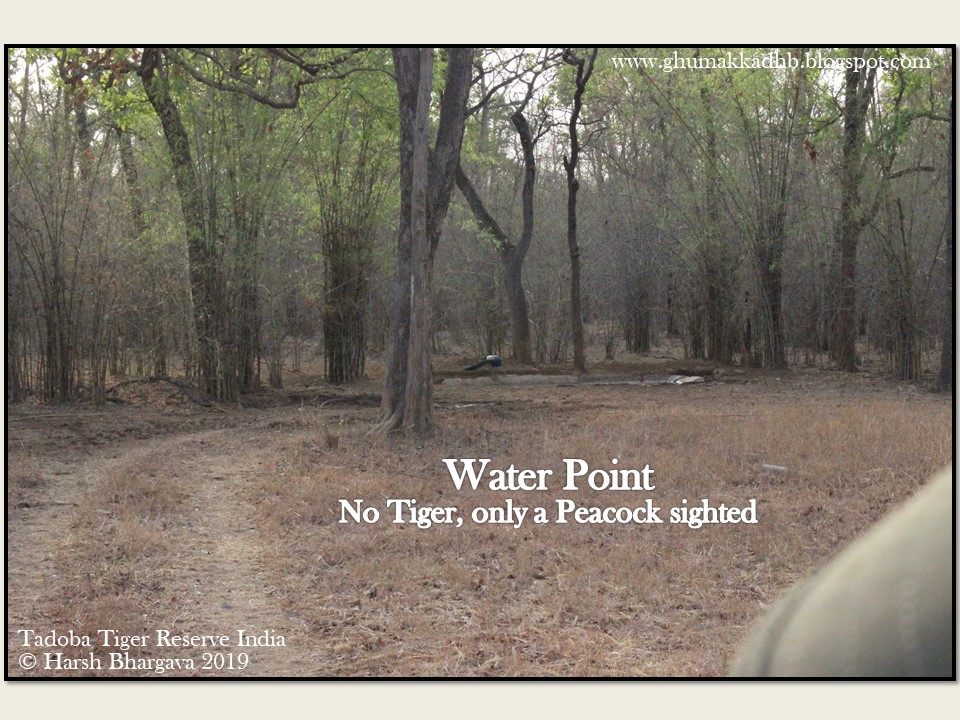
We started with the water points where tiger is expected to come in the searing heat of 47 degrees Celsius. Our first water point below.
Did we see the Tiger? No, but we did spot fresh pug marks. 
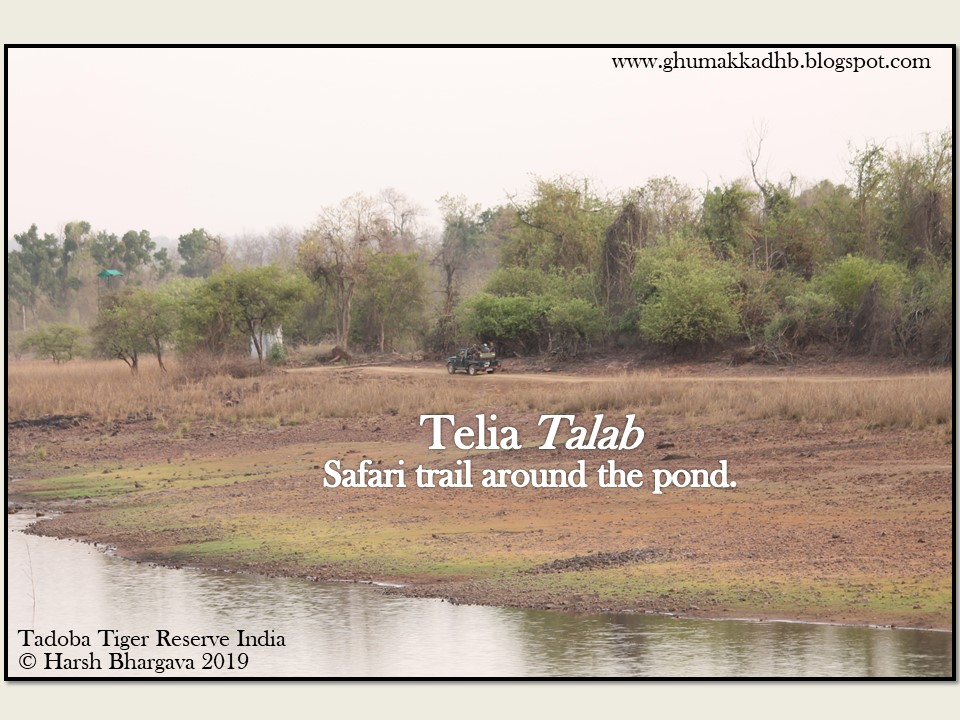
That was encouraging. We pressed on to Telia water tank. Couple of Gypsy vehicles loaded with tourists arrived and waited as the Sun was already hot. Thirty minutes wait yielded no results. We spotted few Cheetals and new shoots springing out of dry branches.


Males have to work hard to attract the attention of females- be it the birds or human beings! Story of getting ignored is the same.


We then decided to move to the second spot which was a transit point for one of the Tigers in the park. Another hour's wait but no joy. Few more spotted deers.


While waiting for the tiger, our forest guide explained about the forest. Each safari vehicle has a trained forest guide. Both men and women carry out the duties of forest guides. The guide also ensures that mobile phones are not used during the safari. Camera permits are issued in advance for the lenses being used. Pictures.


The safari duration is four hours from 5.30-9.30 AM. The visitors get a snack/bio break at a designated spot.


The forest has many ghost trees which shine at night! Feels eerie?

We then moved to Tadoba Lake where Maya with her grown up cubs had been sighted a day before. She was spotted under two large trees on other side of the lake.

We sighted Maya almost a kilometre away. Even with a 300 mm lens she appeared to be no larger than a mouse. However, seeing a tiger in the wild evoked much excitement. More vehicles turned up to see Maya and her cubs getting into the lake and coming out frequently. To cool herself from searing heat. The pictures below also explain why do tigers enter the water backwards? We also saw few birds around the lake.


 Here is a short 10-seconds video clip of Maya.


We were not allowed to go on the other side of the lake. However there was one loan Gypsy closer to the spot where Maya and her cubs were relaxing. On enquiry we were told that it was carrying a documentary filmmaker Mr Muthu who had been engaged by the forest department officially. 

Talking of photography, there is always much to learn with every outing. More so if you have a teacher like this! See the picture below.

You may read our earlier story titled Maya's Maya here which has embedded video clips too. 


So next time when you go to a Tiger Reserve remember the signage below.

How to get there? Click here for driving directions. However, we would recommend taking NH-44 Nagpur Highway from Hyderabad and then turning east after Adilabad for Chandrapur.

Those coming by train from Delhi or Hyderabad have to get down at Chandrapur. There are no cabs at the railways station. However, you can take an auto to the taxi stand at Rs 30/- ride. Once at the taxi stand, plenty of cabs are available. You can bargain for Rs 800/- or so from Chandrapur to Tadoba MTDC where we stayed. It is 30 kms and takes about an hour. This info update is courtesy Aditya Jain who joined us from Delhi.

Safari Bookings continue to be done online. This is the first step in planning a trip to any of our Tiger Reserves in India. Each Safari permit is valid for up to six persons. However, please note that the names once entered can not be changed. One has to get a written permission from DFO Chandrapur for any change. We had to buy additional tickets for two members who had come as replacements, to ride in a 22-seater Canter. Previously, such changes were permitted except for team leader.

Buffer Zone Safaris are also to be booked online now. Till a year back, one could take a buffer zone safari on the spot. It shows rising demand for safaris specially in summer months. Tadoba is a perfect example of managing the man-animal conflict.

Budget: We four drove in a diesel car from Hyderabad to Tadoba and back. As mentioned earlier, we stayed at MTDC Moharli Resort which is value for money. We senior citizens got a discount on our Deluxe AC room tariff. For two nights stay, two safaris, to and fro travel from Hyderabad, all meals and all tips, the whole trip came to Rs 16,000/- per couple. Isn't that a steal?

We end this story with a picture of the safari trail.

We had two more sightings the same day i.e. 28th May 2019. Both in the afternoon! So, take your call and do plan an afternoon safari in end-May which is the hottest period every year. But you have to be well clad to protect yourself from extreme heat in the afternoon.

Stay connected for the encounters with Tiger Bajrang and Sonam the tigress! Coming up next.


Thanks for browsing.   

- Harsh-the-Ghumakkad with Neeta Bhargava/ 10th June 2019

Postscript: Animesh Bhowmick wrote "Tigers are overall part of complete forest eco-system, though at the top of the chain and must be seen like that. You save Tigers, you protect complete eco-system including the human being in the buffer zone. Tadoba happens to be  one of the seven or eight Tiger Reserves in Central India with more or less similar eco-system, with small variations and connected Tiger corridors. Try to enjoy the flavour of each of them" 

#tigerreserve #tadoba #tigersighting #forests #junglesafari #mayathetigress #tigerbajrang #sonamthetigress #india #wildlife  #ghumakkadhb #ghumakkadharsh #pugmarks #tigercubs