Showing posts with label Iron stands for nesting. Show all posts

Wednesday, 14 January 2026

Birding On A Bicycle

 Ever gone birding on a bicycle? Or, explored rural neighbourhood on a cycle? Most readers in urban areas would answer 'no'. But Armed Forces Veterans are different!

Meet Col Tushar Bhakay, a Veteran from Indian Army who cycles to newer destinations on his cycle regularly. Commissioned into Maratha Light Infantry, Tushar served with distinction for 33 years. He has clocked more than 75,000 kms on his cycle across countries and terrains. Ghumakkad is delighted to share this guest story from Tushar. Presently working in Guntur, he cycled to Uppalapadu Bird Protection Centre in Andhra Pradesh. Tushar's story in his own words.

___________ 

When I took up a professional assignment in Guntur, I was rather unsure of what a small town had in store. As I started going around town and the surrounding rural areas on my cycle, I realised there was a lot to see and to experience. 

The rural landscape changes colour ever so often, looking different every couple of weeks. 


I had read about the Bird Protection Centre in Uppalapadu, a village twelve kilometres east of Guntur town – located on National Highway 16 which runs from Chennai to Kolkata. After taking a detour at the village of Takkelapadu, the road joins State Highway 253: venture forth another three kilometres towards Hanumanapalem, and you are at Uppalapadu. 

It is a wetland or a lake called “Cheruvu” in Telugu, with a few small islands bearing some trees. The Forest Department has put up thirty-five metal perches, which double up as 'tree' nesting sites for the birds.


The birds we saw here were of various kinds – pelicans, pintail ducks, cormorants, ibis’, painted storks, herons, flamingos, common teals, and common coots. These winged visitors come down from Siberia and up from Australia. 

The caretaker at the Centre said that most of the birds fly out by day in search of fresh food and fish which they seek out in the Bay of Bengal, which lies around a hundred kilometres further east. They return by nightfall, and their population varies between twelve thousand and sixteen thousand. 

A pathway of a hundred metres designed to keep away the most dangerous predator – the human being – allows for the birds to be watched by interested eyes without any disturbance to their nesting, mating, living, and squabbling. 

The Forest Department ensures a continuous supply of water to the lake, and is also involved in spreading awareness among villagers about the importance of migratory birds.

________________ 

Thank you Tushar for an interesting story. Keep cycling and sharing your adventures with our readers.

Ghumakkad had earlier posted another story on bird protection and conservation effort by AP Forest department in Kolleru. Readers may browse similar bird towers created in the middle of Kolleru lake in the story below.

Kolleru The Pelican Paradise - Picture story of Kolleru Wildlife Sanctuary shows the creation of metal perches for the migratory birds in middle of a lake. The birds have adopted the metal baskets for nesting! 

With rampant destruction of our Environment by mankind, such stories of bird protection are truly heartwarming. Kudos to the Forest Department of Andhra Pradesh Government in India.

Hope you enjoyed the guest story by Col Tushar Bhakay, 15th in our guest-series. Should you have a picture story of common interest, Ghumakkad would be happy to post it here. Only rider is that the pictures have to be original and the matter non-political, non-religious and non-commercial.

Thanks for browsing. Stay connected. Do leave a comment. Few words are enough to encourage us.

     -  Harsh-the-Ghumakkad/ Secunderabad/ Makar Sankranti 14th January 2026

#uppalapadu #birdprotection #Kolleru #wildlifesanctuary #APForestDepartment #GuestStory #birding #bicycling #PelicanParadise #GetawayFromGuntur #GetawayFromHydereabad #ghumakkadhb #ghumakkadharsh #TusharBhakay #Veteran #ArmedForces #MarathaLightInfantry #IndianArmy


Wednesday, 17 December 2014

Kolleru The Pelican Paradise

Kolleru Lake Wildlife Sanctuary- The Pelican Paradise

Winter months herald the arrival of migrant birds like Pelicans, Ducks, Cranes etc from far away places like Siberia. Indian peninsula sees plenty of activity by these winged visitors. Large lakes and sanctuaries become their nesting sites. One such place in Andhra Pradesh is called Kolleru Wildlife Sanctuary (WLS). 

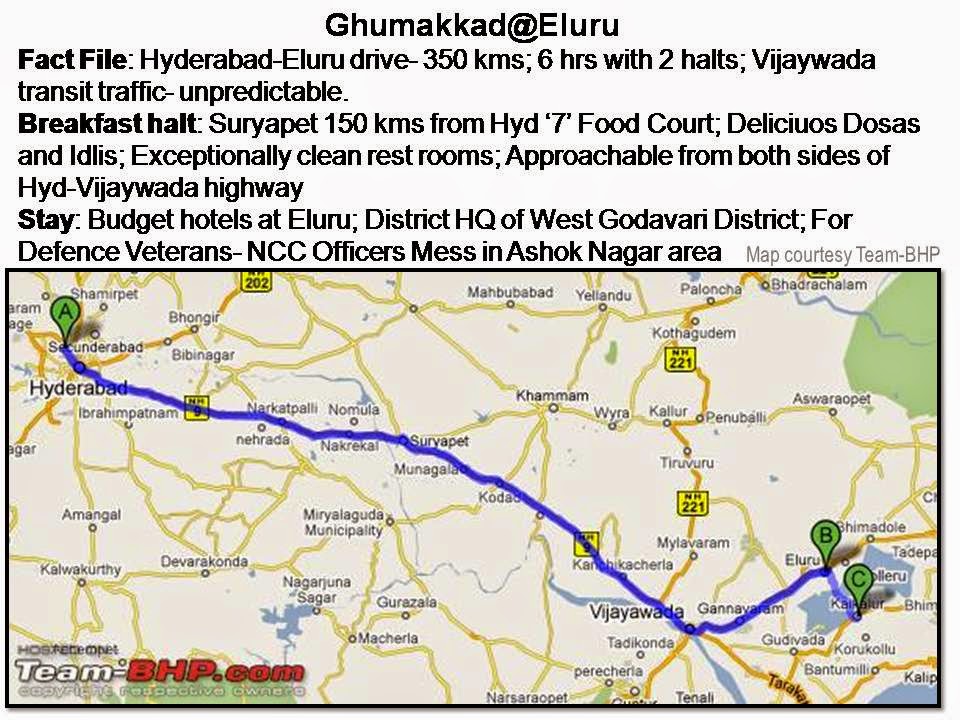
Neeta and I drove 350 kms from Hyderabad to Eluru in our Tata Zest. (see the map below)


One has to cross the lake (or the remains of the lake!) and drive to Kaikulur. Enroute comes a display hut with a view tower maintained by the Forest Department.  A ceiling high signage proclaims Kolleru WLS to be India's 'Largest Fresh Water Wet Land'. See the picture below.
The view from the Viewing Tower enroute Kaikaluru.


Kolleru lake is nature's reservoir to balance the floods between Krishna and Godavari river basins. Average depth is 4 feet. The lake which was once close to 900 sq kms has shrunk to less than half its size-- thanks to encroachments by the fish tanks. Fish tanks are all over! See the two maps-- 30 years apart-- courtesy LakeKolleru.com. The before and after views depict human greed and disrespect for Nature!


After negotiating through the village bye lanes, we reached the 'Pelican Paradise'. It truly is a paradise for bird watchers and Nature lovers. It was a cloudy day with haze-- not a perfect day for photography. But that is not in our control.


The Kaikaluru lake has facilities for hiring  4 or 8-seater boats with life vests during 9.30 am to 5.30 pm. A 20 minute boat ride costs Rs 200 + 100 bucks for the camera. It has a boarding point which can be slippery and dangerous during rains. The boats are powered by an OBM, which does make some noise. But the birds seem to have got accustomed to it! You can get quite close to the birds. The boatman however, has instructions not to cut the engine!
While we were there, we saw a group of young doctors from Ashram Medical College Eluru. See the pictures below. 


The lake has numerous small islands with 'Keekar' trees which are ideal nesting sites for Pelicans and Painted Storks. This spot-billed pelican posed for us.

Why this name 'spot billed'? Because this species of Pelican has spots on upper mandible of their beaks. See the picture below.
As we mentioned, the lake has been badly encroached upon with loss of nesting sites. Therefore man made nesting sites have been created. Basically these are iron stands erected on small bunds in the lake. See the pictures below.
The pelicans have accepted these nesting 'grounds'. See a pelican family perched atop this iron nest!
In contrast, here is a pelican in its natural nest with grass!
Chicks like human babies, are always hungry. You can see a pelican landing on the nest and the beaks of pelican chicks are wide open asking for fish or whatever catch the 'mother' has brought!


Another picture where you can see the spots on this 'Spot-billed Pelican' also called the 'Grey pelican'.

Like all feathered friends, pelicans preen themselves. 
And this pelican flew past showing its majestic wings-- like the fly past during the Republic Day Parade in New Delhi.


Here is Neeta in action taking a video shot  with the iron stands for nesting in the background.
For previous pictures of the pelicans and other birds taken at Ranganathittu Karnataka, please click here.

After the Pelicans, it was the turn of Painted Storks. These tall birds with long beaks nest along with the pelicans.
Painted Storks nest in colonies as in the pictures below.

It is feeding time!
An eye level shot of a painted stork taken from our moving boat.
A stork in flight with a village in the background on lake shore.
Yes, a mud road connects a village in middle of the lake. The path is wide enough for cattle, school children, cyclists and auto rickshaws to ply. See the collage below.


We only hope the lake retains its natural habitat and the pristine beauty for our grand children to enjoy.
Neeta turned around to say good bye to Kolleru Lake .
Hope you enjoyed Kolleru Lake and its surroundings.
Do share your experiences/observations.

Bye till then,
     - Harsh-the-Ghumakkad/ 17th Dec 2014