Ever seen a 'Red Crab'? Not one but in thousands? If not, then head straight to Suryanaka beach, near Bapatla, Andhra Pradesh India. In wet months of June-July, you can witness the grand spectacle of red crabs burrowing and resurfacing as the tide recedes. Watch them swim with the tide or walk in step with each other. Ghumakkad was in Suryalanka on 20th-22nd June and shot these pictures. Captions have been suggested and watermarked by Nikhil, my nine-year old grandson who was with us on the beach.
 Where else are these red crabs found? As per National Geographic magazine, Red Crabs are found in Australia. These crabs also live in the burrows on Christmas Island south of Indonesia and migrate to the coastal zone during wet months. They are thus called Christmas Island Crabs. BBC has featured stories on Red Crabs found on the east coast of India.
During our earlier visits to Suryalanka in the months of January and April, we had spotted the smaller sand bubbler crabs. These tiny crabs created sand galaxies on the beach. See the pictures from earlier posts below.


This time in the month of June, we saw the larger crabs-- the red crabs (about 4 inches plus in size). The tiny crabs (just one cm in size) could not be spotted in large numbers in June except a few. Is it that the sand bubbler crabs grow in to red crabs? Perhaps, some marine biologists can educate us on this question. Google could not answer it clearly.


You can see a red crab burrowing in the short video below.

Most of the crabs had twin antennae of equal height except a few where one 'dipole' appeared shorter.


Nikhil wanted to give all captions in red colour as the story pertained to red crabs. He had his say finally!

All the above pictures were taken on a cloudy morning which gave a dull effect. We were luckier in the evening when the sun came out-- and so did the crabs.
 In these two short videos, you can see the red crabs in action at the beach.
Talking of perception, a military lensman like Ghumakkad saw a marching pattern in the way crabs were walking on the beach!
 Even the crabs believe in the eco-friendly slogan 'leave only a foot print behind and no litter'!

As the shadows lengthened, crabs continued to be at work-- unlike humans who start watching the clock after it is 5 pm in the office!

Apart from the red crabs featured above, we also saw few baby crabs much like the sand bubbler crabs seen in Jan 2014.

 In the next picture, the small crab almost crawled on to my feet at the beach sit out. Wonder if it was the same family or another species?
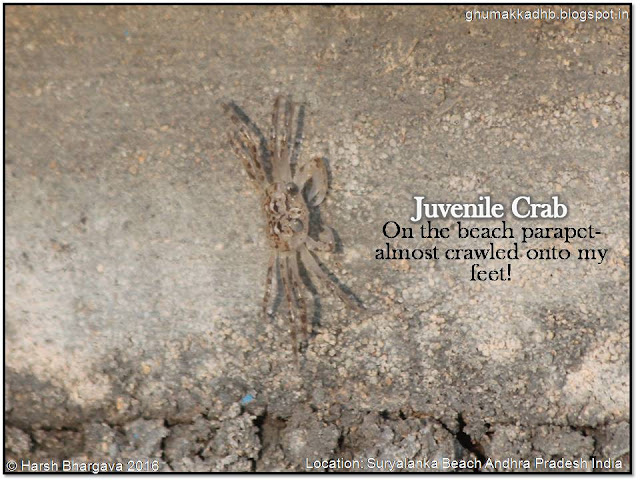
Here is an earlier picture of the tiny crab for comparison.

So, the question remains, are the sand bubbler crabs and red crabs different, or are they same family at different ages?

We would appreciate answer to our query-- do sand bubbler crabs grow up as Red Crabs? Pictures or supporting links are welcome. That is how Ghumakkad learns-- by sharing knowledge.
Before we close, for those readers who feel repulsive looking at a crab, they can admire Suryalanka beach for its glorious sunrise as in the picture below:
 Thanks for browsing,
- Harsh-the-Ghumakkad/ 15th July 2016

During our earlier visits to Suryalanka in the months of January and April, we had spotted the smaller sand bubbler crabs. These tiny crabs created sand galaxies on the beach. See the pictures from earlier posts below.


This time in the month of June, we saw the larger crabs-- the red crabs (about 4 inches plus in size). The tiny crabs (just one cm in size) could not be spotted in large numbers in June except a few. Is it that the sand bubbler crabs grow in to red crabs? Perhaps, some marine biologists can educate us on this question. Google could not answer it clearly.


You can see a red crab burrowing in the short video below.

Most of the crabs had twin antennae of equal height except a few where one 'dipole' appeared shorter.


Nikhil wanted to give all captions in red colour as the story pertained to red crabs. He had his say finally!

All the above pictures were taken on a cloudy morning which gave a dull effect. We were luckier in the evening when the sun came out-- and so did the crabs.

Talking of perception, a military lensman like Ghumakkad saw a marching pattern in the way crabs were walking on the beach!
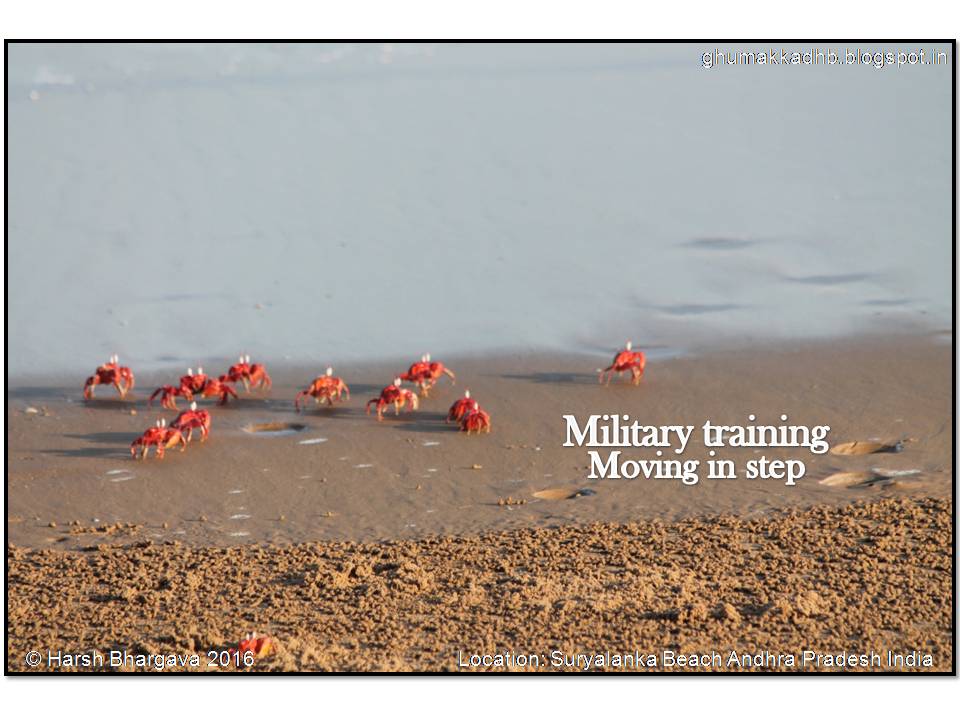

As the shadows lengthened, crabs continued to be at work-- unlike humans who start watching the clock after it is 5 pm in the office!

Apart from the red crabs featured above, we also saw few baby crabs much like the sand bubbler crabs seen in Jan 2014.


Here is an earlier picture of the tiny crab for comparison.

So, the question remains, are the sand bubbler crabs and red crabs different, or are they same family at different ages?

We would appreciate answer to our query-- do sand bubbler crabs grow up as Red Crabs? Pictures or supporting links are welcome. That is how Ghumakkad learns-- by sharing knowledge.
Before we close, for those readers who feel repulsive looking at a crab, they can admire Suryalanka beach for its glorious sunrise as in the picture below:

- Harsh-the-Ghumakkad/ 15th July 2016


