Showing posts with label Raghurajpur. Show all posts

Sunday, 15 March 2026

'Dance Like A Man'

Odisha is often celebrated for its rich and living cultural legacy—from the exquisite Pattachitra paintings and the vibrant appliqué craft of Pipli, to the timeless elegance of Sambalpuri saris, the legendary artistry of Kelucharan Mohapatra, and the enduring grace of the Gotipua dance tradition.  

Gotipua is a traditional dance form historically linked to the famous Puri Jagannath Temple as it developed around it. The dance tradition is believed to have emerged between the 16th and 18th centuries, when the older temple dance tradition performed by female dancers declined. (Wikipedia helped us with this nugget of information)

To continue the ritual and the performance traditions connected with temple culture, young boys were trained to dance and perform in female costume. These boys were called “Goti pua”. Goti meaning “single” and pua meaning “boy”.

The very idea --young boys being trained to embody a tradition built on delicate expression and feminine grace challenged everything we thought our editorial advisor knew about how classical dance is learned, performed and even imagined!

When we first heard about Gotipua we smiled politely—and quietly doubted it--young boys, dressed and trained to perform with such softness and lyrical grace? It sounded almost too extraordinary to be true!

And then we watched a performance! The moment the music began and the young boys stepped onto the stage, disbelief gave way to wonder. The dancers’ movements flowed like silk in the air, every gesture shaped with care, every glance alive with emotion. Strength hid behind tenderness, discipline shimmered beneath ease, and what we had imagined as novelty revealed itself as pure artistry.

We had come curious.

We stayed spellbound.

Sharing few pictures and videos of a live Gotipua performance in Puri, Odisha recently.


Readers may browse the video below to get a real feel of Gotipua performance. Their acrobatics-like sequences can be seen in the YouTube video below.


Another video below shows the entry of the dancers posing as Lord Krishna's chariot.


Next video shows the Invocation, prayers for the Gods to bless the dancers and the world around them.

We thank Kashi and Madhu Mitra for arranging an exclusive performance of Gotipua for our BITS Batch Reunion in Puri recently. It was so inspiring to see the boys pursuing their school studies as well as learn this unique dance form at the Gurukul in Raghurajpur village. In fact their Gurus (teacher-cum-mentor) also accompanied the boys to the venue. He could be seen with the live music team on the left in one of the pictures above.

The teacher later revealed that out of the six, only one dancer was a girl. Although Gotipua has been traditionally learnt and performed by boys dressed as girls, the Gurukul at Raghurajpur broke from the tradition and has trained girls (if they are physically fit) to perform alongside the boys. Talk of gender equality in India! This is the finest example we can think of. Can you guess which Gotipua dancer is the only girl in the picture below?

Bet you couldn't guess it right! She is the 5th dancer from the left standing in the front row. Beaten? Zoom the picture and focus on the feet of the dancers. All of them are wearing ghunghroos whereas only one dancer is wearing a silver payal in addition! 

We all thanked the Gotipua team and gave them a standing ovation.

Thanks are also due to Padma Ramesh for her research and editorial support. She had earlier written a guest story on Iceland which can be browsed here.

Other Indian Dance Forms

Readers may browse our earlier story on Indian dance forms. The picture story which was created to commemorate the World Dance Day, shows various dance forms across the states of India. It also has few PQs-- picturesque quotes superimposed on pictures shot by Ghumakkad -- like the one reproduced below. "Dance is the hidden language of the soul", said Martha Graham famously.

Dances of India and Overseas - experience the dance forms across India as well as the UAE and East Africa.


Feel free to add to the above story.

Closing with a picture of Ghumakkad with the Gotipua dancers. It was an unforgettable performance indeed.

Whether you are a dancer or not, we hope you got our message 'Dance like a Man'!

Thanks for browsing. Do leave a comment, few words will do. It will encourage us.
Stay connected.

   -Harsh-the-Ghumakkad/ Secunderabad and Puri/ 15th March 2026

Postscript 17th March: Many readers had requested for the contact details of the Gotipua Gurukul. Their business card is appended below:

#gotipua #odisi #indiandanceforms #odisha #puri #jagannathdham #traditionaldanceforms #gurukul #raghurajpur #danclikeaman #boysdressedasgirls #abhinaya #grace #reunion #bits1968batch #pilani #bitsians #ghumakkadhb #ghumakkadharsh


Saturday, 10 February 2024

Pottery Magic at Pachdhar Village

'Is it only you who has been making pottery or has it thrived for generations', we asked Laxmi Kant Prajapati. He was quick to respond, 'Yes sir, we have been practicing it for generations'! Laxmi Kant heads one of the 70-odd potter's families living in Pachdhar village off NH-44 near Pench National Park in Madhya Pradesh. This story takes you to Pachdhar village through pictures and videos.


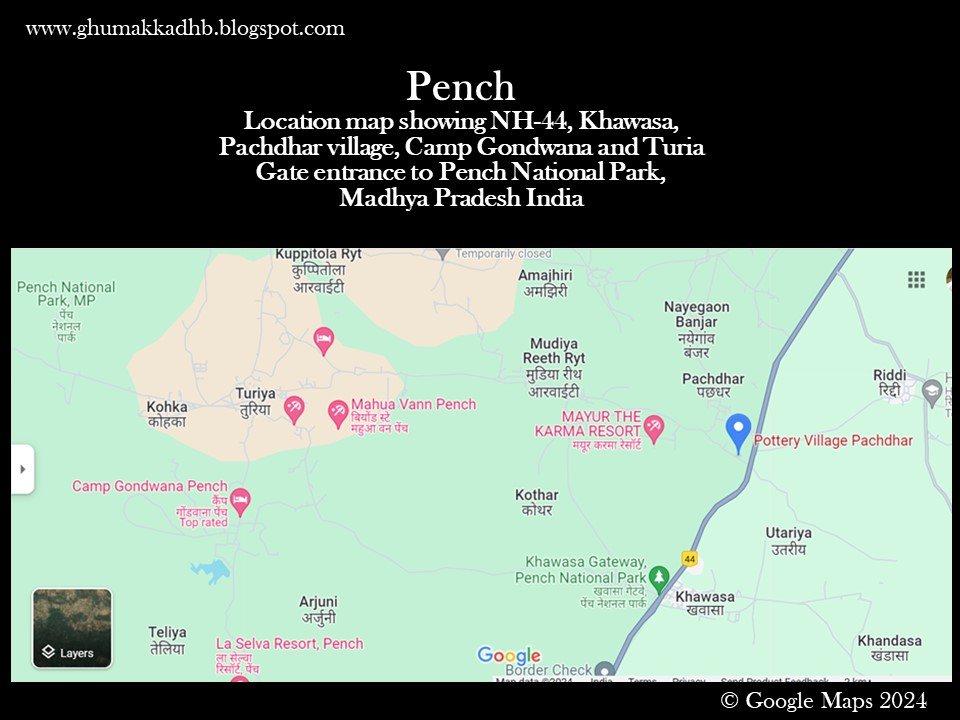
Pachdhar village is shown in blue balloon in the map below. Pench national park is on extreme left in the map.

Who hasn't marvelled seeing a potter's wheel? It creates magic in front of your eyes. And to retain and promote this magic for centuries, the credit goes to the potters living in villages like Pachdhar. They have successfully preserved and promoted India's rich variety of handicrafts. The village is an example of right blend of modernity and tradition. While the pottery is created by hand, the payments are accepted in digital mode. The village has concrete roads and piped water supply. Traditional mud houses are being replaced by cemented structures under a rural housing scheme of the government. Cattle owned by the household are tied in the courtyard. Dung and mud paste is utilised for keeping the floor insect free. Since this village falls in the tribal belt, they are allowed to collect the fallen branches of trees and shrubs for use as fuel. See the video below and notice the wood piled up on the road side. Being close to Pench National Park, the village gets number of tourists as can be seen by the vehicles in the village. Please ignore the background recitation of akhand ramayana (24 hour reading of the Ramayana) in the village temple.

Preserving The Traditional Craft Form

We then met Laxmi Kant Prajapati. He explained that the coarse pottery product is created by the male members of the family. The finer finishing is then done by the ladies. We met her daughter-in-law and asked her how did she pick up the art after marriage. She explained that she also comes from a potter's family in another district and therefore already knew the art. She skillfully packed our purchases in a cardboard carton and even gave a kulhad (earthen ware tumbler) free. No wonder the potters have been able to sustain the traditional art form for centuries. See the video and pictures below.


Here are some more pictures from Laxmi Kant's boutique.


A whole village pursuing the same craft not only for livelihood but also to preserve the knowledge and expertise. This phenomenon is not restricted to Pachdhar village alone. In Odisha, there is a village named Raghurajpur where all 120-odd households practice the art of making Pattachitra paintings. See our video and observe the similarity in the two villages. This video was shot in Nov-22.

As we said in our earlier story titled 'Rural India - Picture of Happiness', Pachdhar village reinforces the point. Do browse the story here, if you haven't.

Since the pottery village is located close to a national Highway as well as the Pench Tiger Reserve, it gets visitors regularly. Influx of wildlife tourists into Pachdhar village reminds Ghumakkad of the Masai Village located close to Serengeti National Park in East Africa. We had visited the village and contributed to its well being besides enjoying a folk dance and purchasing some handicrafts. You may view our story linked below:

The Big Five Live - Takes you to East Africa where wild animals roam in herds of thousands and African Lions can be seen in large prides of as many as 11 lions together!

Pench is a fascinating wildlife destination. The full suite of our stories on Pench is listed below:

Three Masked Men and Four Tigers (coming up)

Jungle Walk at Night - adventure of three 70-year-olds in a jungle in a pitch dark night

Rural India - Picture of Happiness - How the villagers maintain ecological balance while children learn to make handicrafts

Bavanthadi- The picturesque river valley which the Tiger likes (coming up)

Pottery Magic at Pachdhar Village - How the potters sustain centuries-old craft form?

Pench- Where to stay - Camp Gondwana (coming up)

Birds of Pench - Thriving bird life (coming up)

Hope you enjoyed the story and felt empathetic towards our craftsmen from rural India. Do encourage them. Their products are so honestly priced that we didn't have to do any bargaining.

We close with an anonymous quotation which says "Handicrafts are not just crafts, they are our heritage". How true!

Thanks for browsing. More stories of Pench and its surroundings will follow.

    -  Harsh-the-Ghumakkad with inputs from Animesh and Ashok/ Secunderabad/ 10th Feb 2024

#pachdhar #pottersvillage #potterymagic #pench #tigerreserve #madhyaparadesh #artisansofindia #familytradition #villagelife #pottery #ghumakkadharsh #ghumakkadhb #masaivillage #eastafrica #handicrafts