"What is Manas?"
Name of a river in Assam in India named after the serpent Goddess Manasa.
"Then what is this Manas National Park?"
It is a UNESCO Natural Wold Heritage Site. Famous for rich bio-diversity and flora and fauna.
"OK. Which animals are endemic in Manas i.e. found only in Manas?"
The Assam roofed turtle, hispid hare, golden langur
and pygmy hog.
"Did you sight any of these?"
Yes, the golden langur!
"Manas is also known for Tigers. Did you see any?"
No. But our vehicle broke down in the Tiger Reserve.
"What? Are you serious?"
 This conversation occurred many times after we returned from our visit to Manas National Park (MNP) in Assam. Sighting of animals in a forest unlike in a zoo, is never certain. Therefore, one should not be disappointed if tiger or rhino sighting does not occur. Of course, if your safari vehicle breaks down in a Tiger Reserve, that's another story! We will come back to it.
We were a team of 20 Navy veterans and spouses all in their late 60s. We bring you a set of stories based on our visit to MNP in November 2018, which should be read together. Quick links are given below:

Location of MNP
 Manas National Park
As shown in the map below, two-thirds of Manas Park is located in Bhutan where it is called Royal Manas National Park.


The Safari


 Here is a short video clip of these majestic elephants.
The travellers are all set to enter the Park.




 Here is a panoramic view of the Park from the anti-poaching tower:
Hurray the relief vehicle arrives and the Safari resumes!




Instead, we should feel the forest, its smell, the sounds, the trees, insects, birds and everything! Taking pictures is just a small aspect but quite often it becomes the main distraction. We then miss the big picture!


 We end with a quotation about unknown things in life, which kind of summed up our experience that morning.
 We will take you to Mathanguri the northern boundary of the Park in our next story.
Thanks for browsing.
- Harsh-the-Ghumakkad/ 23rd Apr 2019
#manasnationalpark #assam #india #wildlife #tiger #goldenlangur #bansbari #mathanguri #junglesafari #ghumakkadharsh #ghumakkadhb #elephants
Name of a river in Assam in India named after the serpent Goddess Manasa.
"Then what is this Manas National Park?"
It is a UNESCO Natural Wold Heritage Site. Famous for rich bio-diversity and flora and fauna.
"OK. Which animals are endemic in Manas i.e. found only in Manas?"
The Assam roofed turtle, hispid hare, golden langur
and pygmy hog.
"Did you sight any of these?"
Yes, the golden langur!
"Manas is also known for Tigers. Did you see any?"
No. But our vehicle broke down in the Tiger Reserve.
"What? Are you serious?"

We were a team of 20 Navy veterans and spouses all in their late 60s. We bring you a set of stories based on our visit to MNP in November 2018, which should be read together. Quick links are given below:
- Who were the travellers?
- Guwahati the Gateway to North East India
- Driving through the Bamboo land
- MNP- What is so great? (this story)
- MNP- Where crickets sing like Temple Bells
- Bodo Village- Living with Nature
- Where to Stay in Manas
- Deepor Beel A Ramsar Site
Assam has many wildlife sanctuaries and national parks. See the map below.

Location of MNP

As shown in the map below, two-thirds of Manas Park is located in Bhutan where it is called Royal Manas National Park.


The Safari


The travellers are all set to enter the Park.


Fallen trees also have a role to play in a forest.


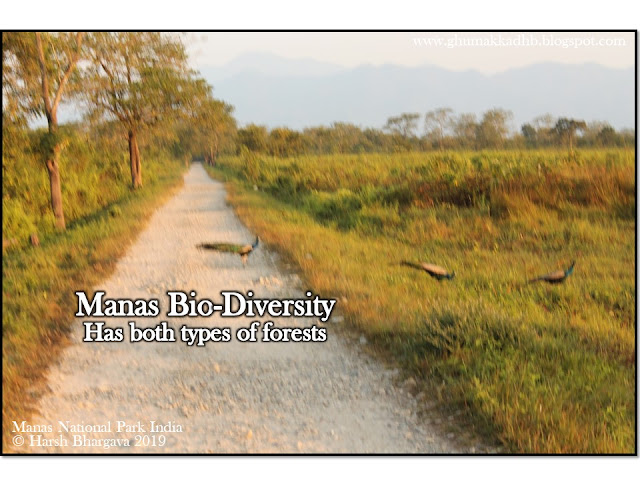
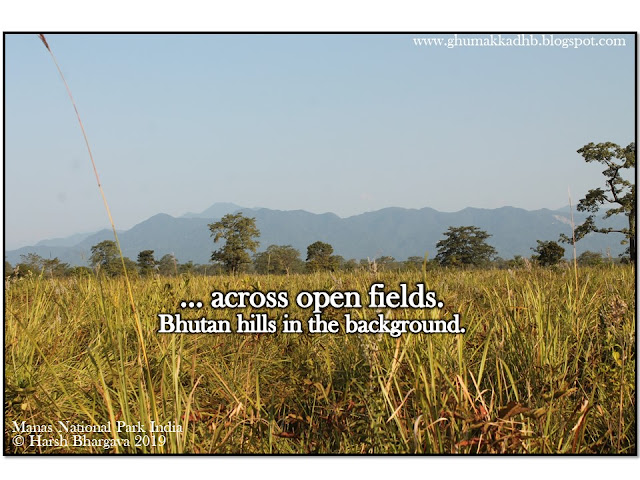
According to Wikipedia, the combination of Sub-Himalayan Bhabar Terai formation
along with the riverine succession continuing up to Sub-Himalayan mountain
forest make it one of the richest areas of biodiversity in the world. The park
is 950 sq km in area and is situated at a height of 61m to 110m above mean sea
level.


Vehicle break down in a Tiger Reserve and ladies seem unperturbed! Because we had four vehicles and only one broke down. And we were stranded near a forest beat camp which had wireless connectivity. So, help was arranged quickly. But Ghumakkad had been stranded earlier in Ranthambor National Park also. Golden rules for such situations are:
- Do not panic.
- Do not leave your vehicle.
- Do not make noise.
- Stay calm.
- Help will arrive since entry/exit of all safari vehicles is tracked.
See the video clip of our vehicle breakdown in middle of the forest.


Hurray the relief vehicle arrives and the Safari resumes!


Instead, we should feel the forest, its smell, the sounds, the trees, insects, birds and everything! Taking pictures is just a small aspect but quite often it becomes the main distraction. We then miss the big picture!


Thanks for browsing.
- Harsh-the-Ghumakkad/ 23rd Apr 2019
#manasnationalpark #assam #india #wildlife #tiger #goldenlangur #bansbari #mathanguri #junglesafari #ghumakkadharsh #ghumakkadhb #elephants
